Friday, April 22, 2011

750 words - Day 2

Where was I up to?

Let's talk about creating a drum solo. This is something I'm currently trying to do at the moment. I've seemingly failed at doing this completely off the cuff. I have a good number of gigs under my belt where I've just gone for an improvised solo in the same spot every night. There's perhaps been one or two gigs where I was happy with the result, and right now I couldn't even tell you what I did that I liked. If I'd recorded every night then I'd have something to go off. Perhaps I'd listen back and they wouldn't be as good as I'd imagined. On the other hand, perhaps nights where I'd thought it had gone badly would sound better than I thought. It's difficult to say without actually doing it.

I've had a few days off since the tour ended and I have another one coming up in less than a week. I've decided I should try and write a solo. This doesn't have to be a note for note thing, just an idea of how long it'll be and a series of licks that I know work in the context and increase in excitement so I can build to a climax.

Step 1 is going to be deciding on the temp. This particular song seems to change from night to night so I want to make sure that whatever I come up with will work at all tempos we might play it.

Then I'll decide on the length. I'll sing through the section before the solo, imagine a solo building to a climax, then returning to the song. I'll do this a few times until I find a length that seems good.

Next I'll start thinking about licks that I already know that work at that tempo. This isn't really something I've done before, but there are definitely 'licks' that I know already which could be utilised. For the first time I'm going to have to come up with names or descriptions for them. This should help when it comes to recall time. I'll come up with as long a list as I can - just throwing everything into the pot.

From there I will work towards structuring a solo from what I know already. If I don't feel like I have enough chops I'll take a look around youtube and records I have and see if there are things I could steal from other drum solos. Some things I'll inevitably have to spend some time figuring out - but that's a good use of my practice time anyway.

I want the solo to be enjoyed by as much of the audience as possible. To me, this means playing something that's melodic with good phrasing and things that people can latch on to. Plus, perhaps, a bit of fast double bass drum and arm crossing at the end :) That always works.

Let's think about some of the options.

What would it sound like if I came up with a 1 bar rhythmic phrase and repeated that with different orchestration for a few bars?

How about if I went for a 2 bar rhythmic phrase and used the first bar of that for a second and third repeat while changing the second bar each time.

Can I come up with rhythms interesting enough so I don't feel like I have to fill all the gaps with rolling snare drums. Could these rhythms be 1/8 notes, or even 1/4 notes?

How many ways can I think come up with for playing a 1/4 note rhythmic solo to make it interesting? Orchestration. Dynamics. etc.

Should the solo be based around a groove? Or free form? What about finding a relatively simple groove to play off and building to a climax without losing that groove?

Can I come up with a set of questions which I could ask of any drum solo to help deconstruct it? What would they be? The obvious initial ones would be...

Is this solo over a vamp or just drums?

If it's just drums is it completely free or is it still part of the song (i.e. does the drummer sing a vamp to himself or count bars?)

Those 2 questions would be enough to narrow down all the solos I can find to those that I could analyse to fit my current situation. Even if they're in a different tempo/style/time signature I could still get useful information from them.

750 Words - Day 3

So, drum solos. I played around a little bit yesterday. I noticed I was procrastinating. On my list of things to do was find good drum solos and write down the bits I liked. Also, to write down all the licks I could think of that might work. I kept putting it off. I wanted to 'write' a solo before the weekend, but I found that I really didn't want to start on the task.

With a bit of reflection I realised the reason was that I didn't feel like I was capable of creating something I was happy with. I didn't want to start on it for fear of realising that I couldn't come up with the goods. Which, if you think about it, is pretty silly. I already know that I can't do what I want at the moment, and all I was intending to do was to move closer to that goal. I suppose, but giving myself the deadline of the weekend to create a 'great' solo, then I was potentially setting myself up for failure and thus putting myself off even beginning the task.

Instead, I just sat at the drums and played around. I tried different tempos and realised, to my surprise, that I ended up using totally different 'licks' if I played at 110bpm, than if I played at 100bpm. Some things just didn't work at both speeds and if I tried to throw them in I'd speed up (or slow down). That was an interesting discovery as the song would work at both tempos.

The next thing I realised was that I have a tendency to always begin phrases in the same places. That gets boring, but it's hard to break out of. At one point I went to play something in my head which started on the snare with my right hand. I accidentally didn't play an accent so the rhythmic idea sounded like it started a 16th note later. Immediately it sounded more interesting than what I'd been playing before.

So, I took that concept and expanded on it. If you think in 4 bar phrases try giving yourself some boundaries. For example:

  • Begin all phrases in a certain place. Try the 2nd 16th note of the bar, or the 'a' of 2. Work this through all possibilities.

  • Begin all phrases on a certain drum, or cymbal. If you begin a phrase on a lone crash it'll make a nice change. You could also begin a phrase with a stepped hi-hat. Or a x-stick.

  • End all phrases in a certain place. Perhaps over the bar line.

  • End all phrases on a certain drum/cymbal.

  • Try intentionally always beginning and ending a phrase on the same beat and instrument that you start it on.

These are all just ideas to help broaden your sound palette. You'll undoubtedly find some of them more difficult than others. Also, you'll HAVE to count in order to know that you're actually starting/ending in the places you're telling yourself too. This can be difficult, but it's definitely something you should be able to do.

You may have to simplify the kind of thing you play in order to meet these criteria. That also is a good thing. As your competency increases you'll find the complexity of what you play will also increase. It's better this way than just playing complex things without thinking about them.

The main thing is to keep trying new things and making mental notes of what you like and what you don't. This is the process of creation and evolution of your style. TRY EVERYTHING and then EDIT.

Think about it. You know what you like and what you don't like when listening to other drummers. I suspect you don't always like EVERYTHING that even your favourite drummer plays. It'll seem more interesting and creative than what you play, but that's just because it's new and different to what you play. If you can come up with ways to make things you play be 'new' and 'different' to what you usually come up with then you can apply the same judgement to your ideas.

One final thought. Don't judge them too soon or you'll put yourself off. Give yourself creative freedom to try everything. Ideally you'd record it, then listen back when you've forgotten what you played. In that way you'll be able to judge it as you would someone else's playing.

750 words - Day 1

So, what if I start using these 750 words to write down some of my ideas? Perhaps on getting better at the drums. I know, for example, that it requires the application of time, and attention. The time being the sitting and playing and trying to make things do what I want, and the attention being the stepping back, analysing, and checking that I'm applying the time to the right things. You don't want to spend a week of solid practice working on something only to realise at the end of it that you've gone in the wrong direction.

Those subtleties in difference of direction can turn into big deviations from where you intend to go. It's like steering a ship - you need to keep it on course. Of course, you don't want to do the opposite and use all the time for attention as then you don't actually get anywhere. Plus, over thinking something isn't necessarily a good thing as you learn things as you get better. So, small steps and small corrections is the way to go.

What do you do when you're not sure which direction to go in? You know that you can be better. You notice differences between what you're playing and what other people are playing but you're not sure what the differences are.

Step 1 is to record (preferably video) yourself playing the thing that you're comparing yourself to. You might be surprised to find that you can already do it. If not, then it's likely that the differences will become more obvious. Either the difference will be technical - i.e. you know what they're playing but you either can't do it at all, or you can do it but it doesn't sound as good; or it'll be conceptual i.e. they have ideas that you don't.

The second one is hard to do anything with. Even in writing that sentence I realised that it doesn't make sense. For one thing, you don't know whether or not they created their thing on the spot. You also don't know that they wouldn't think the same of something you play - whether you worked it out beforehand or jammed it.

When it comes to creating things on the spot one thing to pay attention to is whether you really know what you're playing. I always have a tendency to reach for things that are too complex to really follow - even for me (and I'm playing them).

Try setting yourself boundaries - eg. only allowed to play in 8th notes, or triplets. Or, you have to KNOW what subdivisions you're using at all times. That way you can tell whether you're really in control or if you're just letting your arms go wherever they want.

Not that letting them go wherever they want is always a bad thing. If you let them do that and you're happy with the results then it's fine. It's when you're not happy with the results that you need to rethink things and take hold of the reins.

Sunday, March 21, 2010

New Gary Novak transcription in the Drum Vault


I've added a couple of things to the drum vault. Firstly one of my favourite drum solos by Gary Novak. It's from Tone Poem on Chick Corea's "Paint the world" and is a fine example of Gary's playing. I also included a midi file of the solo vamp and the drum part so you can open it and slow it down to whatever tempo you want.

Secondly I was asked via email to transcribe a drum fill from 'Fifty Fifty' from Zappa's Overnight Sensation.

You can access the drum vault on the left of the lessons page

Thursday, March 18, 2010

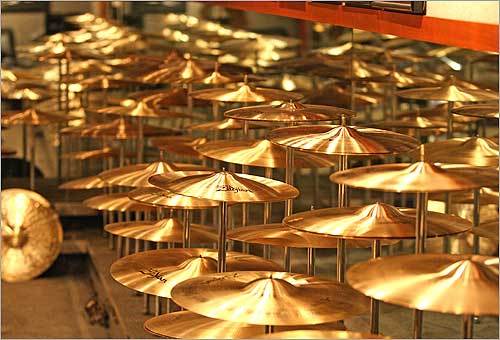
Cymbal choice and how to use them


I was recently asked a question on the forum about cymbals; how to choose them, when to hit them, etc. It reminded me of a lot of questions I had when I started out. Here's what I replied...


The few times I made the trek to the nearest decent drum shop (2 hours away) to choose my own cymbals I was disappointed when I got home and tried them on the kit. Then I started checking out what my favourite drummers were using and just ordered them online and was generally happier with what I ended up with. A lot of drummers would scold me for that as cymbals can be a very personal thing, but I've found Zildjian's online cymbal chooser to be very useful. The samples on there are pretty accurate. Obviously there can be pretty big differences between two of the same cymbal - for example I've had three 15" A custom crashes in my time and each one sounded different. However, having said that, they're still within a range and I can identify their characteristics with what I hear on the Zildjian site.

If you're just starting out don't worry too much about getting the 'right' cymbal. There isn't a 'right' cymbal - it's all about what you like and don't like and you'll only find that out with time and experience. Some cymbals you buy you'll grow to love; others you'll find you don't like as much and may end up selling on eBay.

With regards to when to move to the ride, or open the hi-hats, or use the bell or hit a crash, etc.
Most of those will answer themselves over time. I could try and explain my ideas about when to hit a crash, how much to open the hihats, etc. but it wouldn't really make sense until you had the same experiences I'd had.

The best 2 pieces of advice I can offer are:

a) Pay attention to what other drummers do on songs you like. Make mental notes about where they go to a different cymbal, place the crashes, use the ride bell, etc. Try to imagine what those parts of the song would sound like if they'd stayed on the hihat instead of going to the ride, or if they'd used a splash instead of a crash or just omitted the crash all together.

b) Record yourself playing on gigs and in practise sessions. This is most relevant when you're playing music with other musicians. When you're listening back you'll know whether things sound good or not. Perhaps you'll realise that you should have gone to the ride in the chorus. Perhaps play the song a few times and try different cymbal orchestrations - then listen back and compare and see what you prefer. That's what it's all about in the end. There's no right answer - it's just a case of what sounds best to you.

Obviously the possibilities are endless. Try not to feel restricted in what you can do. If you're coming up with drum parts for a song you should let yourself be as free as possible. Allow yourself to try things even if you think they might sound rubbish. Every time you try something and you don't like how it sounds you're one step closer to finding something you think sounds right.

It can be really useful to get some music minus drums to play along to. That way you can try all sorts of ideas without boring a room full of musicians by getting them to play over and over. If you're working on parts for a song for your band then maybe get them to play along to a click so you have something to work with on your own time.

Quite often when I'm working on a new song I'll find myself singing it while I'm in the shower/cooking/running/etc. and I'll hear a fill or groove in my head that I think will work well. I either jot it down on a bit of paper or sing it into my phone. Anything so you can remember it when you're at your kit. Then when you're back at the kit you can try it and see if it sounds as good as it did in your head. If you don't have a phone with a voice recorder on it you could even call yourself and leave yourself a voicemail.

Here are a few things you could try to expand your musical cymbal palette:

Hi Hat
-------
i) Try combinations of hitting it on the top with the tip of the stick, and on the side with the shoulder.

ii) Vary the pressure of your foot - you can range from very tight short hihat notes (a la Stewart Copeland) to looser notes with more sustain, to half open, to taking your foot right off the pedal. You'll only know what sounds best by recording it and listening back.

iii) Try adjusting the pressure of your hihat foot to allow the hihat notes to last an 8th note or a quarter note.

iv) Try playing the bell of the hihat


Crash
------
i) Crashes can sound cool when you hit them with the kick drum. This works well on the 1 of a new bar after a big fill.

ii) Try NOT putting a crash and kick on the 1 after a fill.

iii) Try putting a crash on the 1 of a new bar but with no kick.

iv) Try crashes in different places. Maybe on the '4'. Or on the 'a' of 4 with a kick on the 1.

v) Try crashing with a snare instead of a kick.

vi) Try crashing with a tom (Vinnie quite often combines floor tom and crash)

vii) Try hitting 2 crashes one after another. See how it sounds when you use different pairs of crashes.

viii) Try choking a crash cymbal (grabbing it with your hand to silence it) to stop it ringing into a quieter section of the song. This can be very effective.


Orchestration
-----------------
A basic rule you might follow for orchestration is to use smaller faster cymbals when accenting short sounds in the music (a horn stab or an accented guitar chord), and to use larger crashes with more sustain when you're accenting things of longer duration (a big sustained guitar chord, or held bass note, etc). Short sounds might be a splash or small crash, or a quick open hihat or maybe the ride bell. Longer sounds would be larger crashes, crashing the ride, china, or an open hihat left to ring.


Volume
---------
One thing to note is that cymbals often carry much more than the drums. In a live situation in a smaller venue you often don't need to mic them as they cut through. When recording they're often too loud in the overheads in comparison to the overall kit volume. One tip I found useful is to hit them more gently. They sound 'bigger' and they make the kit sound more powerful when it's not drowned by cymbals. Crashes also sound different depending on how hard you hit them. Again, record yourself trying different volumes, listen back and decide for yourself.


With regards to product descriptions (washy, dry, etc). they're the sales team's best efforts to describe something that you really need to hear to appreciate. It's like reading menu items in a posh restaurant. The same goes for the terminology that's now so ingrained - ride, crash, splash, hihat, china, were all coined at some point in time.

The best thing is to go and try out different cymbals and see what you like. Zildjian's website has a cool feature where you can listen to samples of each cymbal - that might help you understand what they mean when they say 'dry' (doesn't ring or resonate so much - not so many overtones.) Still, you really should hear before you buy. You wouldn't paint your living room with a paint colour you'd only read the description of...

If you have any thoughts you'd like to add, come and join in the discussion on the forum

Friday, January 01, 2010

The Rhythm Machine

In March I went to New York and took some lessons with Billy Ward and Robby Ameen. One of the things Billy got me to do was play a groove then begin to gradually embellish it without losing the basic underlying groove. He specifically wanted me to hear in my head what I wanted to hear on the kit BEFORE I played it - rather than just throwing my arms around and hoping for the best.

At one point he came over to me and started singing rhythmic phrases for me to try and implement. This was his way of simulating what it's like when you're playing live with other musicians. Perhaps you're on a gig and the guitarist plays a rhythmic phrase and you want to mimic that on the toms, or the bass player does something cool and you want to answer his phrase with your bass drum.

Practising in this way is very useful training but it's difficult to be surprised or challenged by your own ideas. It was great having Billy there shouting phrases for me to mimic but once I got home and was practising on my own I struggled to come up with new ideas.

My lesson with Robby Ameen involved a similar idea. The two of us played a slow songo groove then Robby would play a 1 bar rhythmic phrase which I then had to repeat. Once I'd got the hang of that he'd extend it to 2 bars. It's challenging remembering what was played then executing it all while keeping a left foot clave going. He'd switch between 8th notes, triplets and 16ths and came up with things which I'd never have come up with on my own.

When I had some time off over the summer I started looking into a way of creating some software to do the rhythm generation for me. I found a program called 'Max' and I managed to write the Rhythm Machine in the 30 day trial period.

The program is pretty flexible and there are many ways you can use it. Unfortunately it sometimes gets out of sync with itself on slower machines. I think this is an inherent problem with way Max. Still, it can be a very useful tool and it's worth checking out.

Download it for free here and let me know how you get on with it.

Cheers,
Joe

Saturday, December 19, 2009

Merry Christmas!


This year's been another busy one. Come February it'll be 3 years since I joined Wishbone Ash. I can't believe how quickly that time has passed. We started the year in Europe - mainly Germany - with a 5 week tour. It was cold but it was good to be working at what always used to be a really quiet time. We took 10 days off to go skiing/snowboarding which was great fun but I had to be very careful not to break anything. In the weeks leading up to the ski break I'd been figuring out how I'd get through a set without the use of one of my limbs. I figured I could just about pull it off but didn't really fancy having to put it into practise.

In March I took 10 days out and visited New York to take a few lessons with some of my favourite drummers. I was grilled by Billy Ward, Jon Riley helped me with my jazz chops, Robby Ameen gave me some afro-cuban tips and Mike Clark demonstrated how to play like a genuine funk legend! It was hugely inspiring and I came home with lots of new ideas to work on. If you ever find yourself in New York I highly recommend hooking up with one of these guys. I was really impressed with their massive enthusiasm for the instrument and was struck by how each one had their own completely distinct style.

A UK tour followed shortly after my trip. Andy Powell has kept Wishbone Ash going for 40 years - a pretty impressive feat! In celebration of this fact we did a 40th Anniversary gig at Shepherd's Bush Empire which was filmed for a DVD (check it out at the Wishbone Ash store)

Summer was a bit quieter but I got the opportunity to work on new material for the MasterClasses. The response to these lessons has been great and I hope to get some new ones up there in the not too distant future.

We played a few European festivals in August. One of them was with Slade. I obviously know Slade music but they were really before my time and I only recognised Dave Hill because I'd seen Bob Mortimer's impression of him on Reeves and Mortimer. It was spot on!

We toured the UK for a second time in October then spent 10 days in November working on a song for a new single. Current plans are to release it next year. I'm very pleased with how it turned out.

I've got a month off over Christmas and have been doing some Custom Drum Track sessions and getting in some much needed practise. Next year looks like it'll be more of the same. We head out to Germany in January. I'm intending to visit the Sonor factory to see how my drums were made - I'll post some photos from the trip. Later in the year we have some gigs in South Africa with Deep Purple and Uriah Heep which I'm very excited about.

That's all for now. Have a wonderful Christmas and here's to 2010!

Joe